Associate of Science in Environmental Science
PROGRAM MISSION
The AS Environmental Science program is designed to prepare students to understand the multidisciplinary nature of environmental concerns, to be able to analyze problems using multiple perspectives, to employ appropriate actions to promote environmental Stewardship, and to promote k’e.
The AS Environmental Science program supports the college’s goals of studying Dine’ culture, preparing for further studies and employment in a multi-cultural and
technological world, and fostering social responsibility, community service and scholarly research that contribute to the social, economic and cultural well-being of the Navajo Nation. We do this by studying Navajo understanding of nature, providing excellent education that prepares our students for their future goals and inspires them to be active in creating hozhoon in their communities.
PROGRAM GOALS
1. To connect traditional and scientific ecological knowledge.
2. To understand and employ appropriate methods of environmental stewardship.
3. To promote lifelong learning.
PROGRAM STUDENT LEARNING OBJECTIVE
Nitsáhákees – Increase understanding of scientific concepts
PSLO #1 Demonstrate an understanding of the theory of evolution.
PSLO #2 Demonstrate an understanding of population and ecosystem dynamics.
Nahát’á – Use scientific methodology
PSLO #3 Be able to use models to explain and predict natural phenomenon.
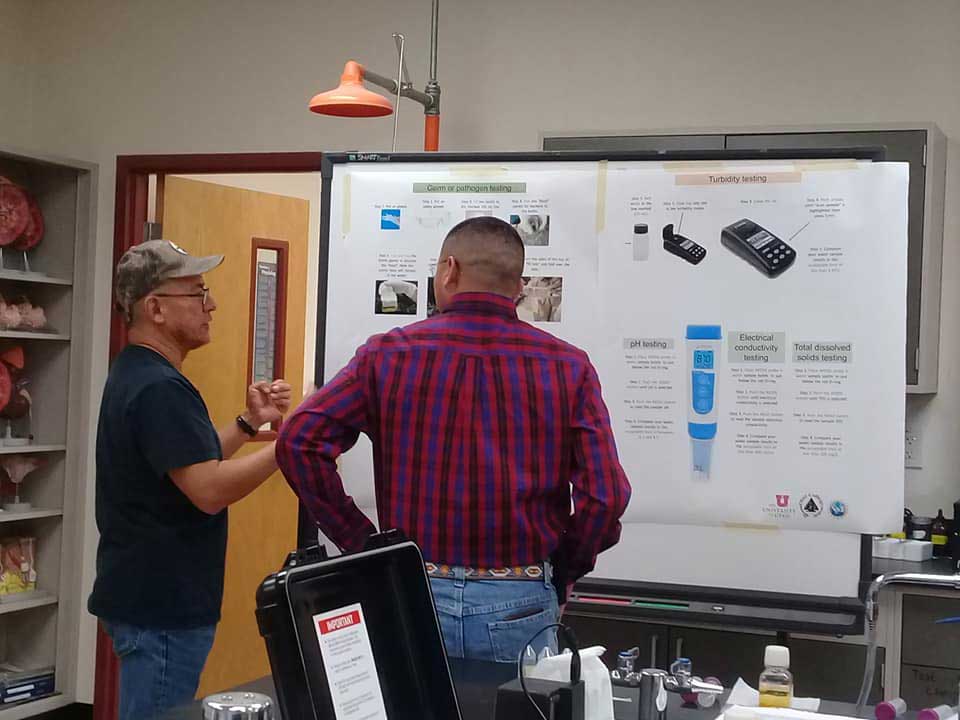
PSLO #4 Use standard test for soil, air, water, plant, and biodiversity studies,
Iiná – Apply knowledge in everyday life
PSLO #5 Use traditional ecological knowledge to understand different worldviews
about human relationships to the environment.
Siihásin – Self-assessment
PSLO #6 Students will demonstrate confidence and desire for lifelong learning.
ANNUAL ASSESSMENT PLAN
Artifacts for all outcomes will be collected during the spring semester. Once per term, each spring semester.
Artifacts for each class will be collected once per term and analyzed by the instructor for that class. Raw data (digital format) will be stored by the instructor and reported to the division chair and the SLAC representative, where they also will be held. Agroecology/Env Sci faculty will participate in division-wide assessment meetings and also meet as a smaller group as needed.
2025 – 2026 Checklist
Associate of Science Degree
Environmental Science (60–61 credits)
| General Education Requirements | Credits | Program Requirement | Credits |
|---|---|---|---|
| Communications ENG 101 College Composition I ENG 102 College Composition II | 6 | ENV 101 Intro to Environmental Science | 4 |
| Humanities / Fine Arts Choose two courses with different prefixes from: ARH 110; ARH 211; CW 208; ENG 231; ENG 233; FA 106; FA 115; FA 178; HUM 152; LIB 110 Course 1: __________ (3.0) Course 2: __________ (3.0) | 6 | Upper Division Elective Courses
| — |
| Mathematics (or another MTH class as identified by degree program & placement) MTH 110 College Algebra | 4 | Lower Division Elective Courses
Minimum Elective Total: 16–17 hrs | 16–17 |
| Navajo Studies One NAV course (placement): NAV 101/102/201/202/211 (3.0/4.0) NIS 111 Foundation of Navajo Culture (3.0) NIS 221 Navajo History to Present (3.0) | 9–10 | Program Credits Total | 20–21 |
| Laboratory Science Must take BIO 181 and CHM 151 BIO 181 General Biology I (4.0) CHM 151 General Chemistry I (5.0) | 9 | Social & Behavioral Sciences 1 HST and ANT 160 HST (Choice: 101, 102, 135, 136) (3.0) ANT 160 Nav Ag Hist Precontact to Present (3.0) | 6 |
| Gen Ed Credits Total | 40–41 | — |
IMPORTANT: To fulfill the General Education Science Core, students are required to take BIO 181 and CHM 151 courses.
Note: Must pass all courses with a grade of “C” or higher.
DEAN'S OFFICE
Acting Dean, School of STEM
Tuba City Campus
Phone: (928) 283-5113 ext. 07520
Research Labs: 7538, 7539
Email: stabassum@dinecollege.edu
Administrative Assistant
Tsaile Campus
Phone: 928-724-6731
Email: syazzie@dinecollege.edu